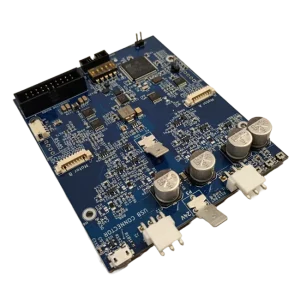
Description
More than a motor controller. A node in your distributed robot.
Most FOC controllers on the market — ODrive, Roboteq, Tinymovr — require you to write a ROS driver layer: a node that sits on your compute unit, translates ROS topics into serial or CAN commands, and handles latency introduced by that extra hop. The Magni 6 24V/36V eliminates that layer entirely.
Using Pico-ROS and the Zenoh communication protocol, this controller publishes and subscribes directly over ROS 2 topics — making it a first-class node in your robot’s distributed graph, not a peripheral you’re driving from the outside. The result is deterministic, low-latency motion control that stays synchronized with your sensor pipeline, navigation stack, and any other ROS 2 processes.
Beyond motor driving, it functions as a live system node — reporting bus voltage, wheel odometry, and per-motor state in real time. Supporting up to 45V and 10A continuous per motor, it’s capable of driving platforms with payloads exceeding 100 kg.
Built for where ROS 2 is going — not where it’s been.
With ROS 1 Noetic reaching end-of-life in May 2025, the ecosystem has fully shifted to ROS 2. While many controller vendors still ship ROS 1 packages and leave ROS 2 migration as an exercise for the user, this controller was designed from the ground up for ROS 2’s real-time, distributed architecture.
Ideal for:
- University and corporate robotics research labs
- Mid-scale AMR/AGV production environments
- Ground rover platforms with payloads up to 100+ kg
- Teams standardizing on ROS 2 Jazzy or later
Technical Specifications:
- Nominal Voltage: 24V/36V
- Maximum Voltage: 45V
- Maximum Motor Current: 10A per motor
- Motors Supported: 2 × 3-phase brushless (BLDC / PMSM)
- Control Method: Field-Oriented Control (FOC)
- ROS Integration: Native — Pico-ROS + Zenoh (no host driver required)
- Realtime Telemetry: Bus voltage, motor state, wheel odometry
- Form Factor: 105 × 86 mm
- Payload Capability: 100+ kg (platform dependent)